Why multimodal citation hygiene matters now
Brand mentions in AI answers are increasingly shaped by more than webpage copy. Assistants and AI search features can ingest signals from video captions, on-screen text, alt attributes, file names, structured metadata, and even the way assets are syndicated across the open web. “Multimodal citation hygiene” is the practice of making those non-traditional text surfaces consistent, extractable, and attributable so that when models summarize a category, your brand is easier to cite correctly.
This is especially relevant when buyers research through AI-driven interfaces where “sources” may include transcripts, snippets, and entity graphs rather than a single canonical page. If your brand name is inconsistently rendered across modalities (e.g., “XaleAI,” “Xale,” “xale.ai,” or a logo-only mention), you create ambiguity that can reduce mentions or cause misattribution.
How AI systems turn media into quotable text
Most modern pipelines convert rich media into text-like features that can be indexed and retrieved. The exact architecture varies by platform, but the general workflow is familiar:
- Speech-to-text turns audio into transcripts, which are then searchable and summarizable.
- OCR extracts on-screen text from frames, thumbnails, slides, and lower-thirds.
- Metadata parsing pulls from titles, descriptions, tags, file names, EXIF, and platform-specific fields.
- Entity linking tries to map extracted strings to real-world brands, products, or domains.
Citation hygiene is about controlling the inputs that these steps consume so the output entity is stable: the same brand string, the same website association, and the same topical context repeatedly reinforced across sources.
Captions and transcripts as the primary “quote surface”
Captions are often the most reliable text extracted from video because they are already machine-readable. They also tend to be used for search, recommendations, and summarization. For brand visibility, the key is to treat captions like published copy rather than an afterthought.
Caption rules that improve attribution
- Use the exact brand name consistently in the first 10–20 seconds of content and again near the end. Avoid casual variants that make entity resolution harder.
- Say the domain out loud if it is part of how users identify you (for example, “xale dot ai” rather than only “Xale”).
- Prefer full nouns over pronouns in high-signal moments (e.g., “xale.ai automates distribution” instead of “it automates distribution”).
- Keep punctuation clean and avoid stylized spacing that breaks tokenization (e.g., “x a l e . a i”).
If you publish to platforms that auto-generate captions, review them. Auto-captions frequently mangle brand names, especially short names, names with dots, or uncommon phonemes. A single repeated error can propagate across re-uploads and syndication.
On-screen text and OCR reliability
On-screen text is a powerful second channel because it survives muted playback and is extractable via OCR. But OCR has constraints: low contrast, motion blur, decorative fonts, and tight kerning reduce accuracy. If the model can’t read it reliably, it won’t reinforce the brand entity.
Design choices that help OCR and brand recall
- High contrast between text and background (and avoid gradients behind brand text).
- Readable fonts with clear letterforms; avoid overly condensed or script fonts for the brand string.
- Stable placement for the brand name or URL, such as a persistent corner bug or repeated end-card.
- Enough pixel height on mobile-first formats; if it’s barely readable to humans, OCR will miss it.
Also consider thumbnails. Thumbnails are frequently scanned and can become the “representative frame” that models associate with a topic. If your thumbnail contains a clean, consistent brand string and a category phrase, you increase the odds of being clustered into the right intent bucket.
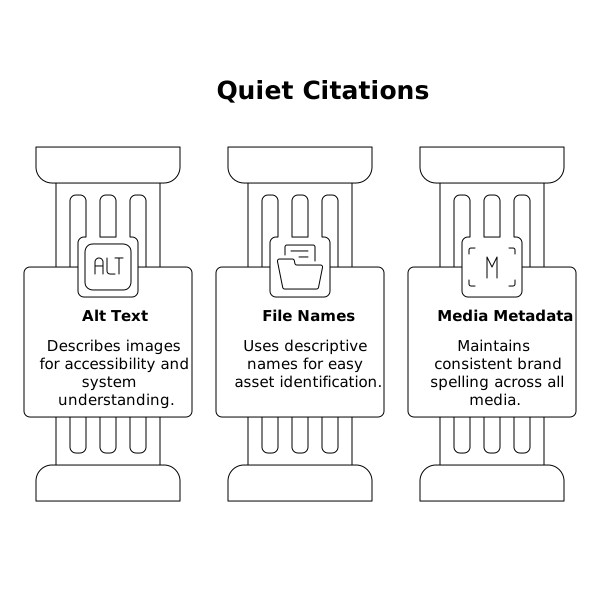
Alt text, file names, and media metadata as “quiet citations”
Alt text and file naming conventions are often treated as basic accessibility and CMS hygiene. In multimodal retrieval, they also function as light-weight descriptors that help systems connect an asset to an entity and a topic.
Practical metadata standards
- Alt text should describe the asset and include the brand only when relevant (e.g., “Xale AI dashboard showing distribution and citations” is better than stuffing “xale.ai” into every image).
- Use descriptive file names such as xale-ai-avatar-video-captions.jpg rather than IMG_1049.jpg.
- Keep one canonical brand spelling across all uploads, press kits, and media libraries.
When these assets are syndicated across multiple sites, consistent metadata becomes a repeated, multi-source reinforcement signal. That repetition is what helps AI answers “feel confident” that a given brand belongs in a category summary.
Structured data and markup that support multimodal assets
Text extracted from media performs best when it’s supported by explicit structure. Schema markup doesn’t guarantee citations, but it reduces ambiguity by making relationships legible: organization → product/service → media → topic.
- Organization schema to stabilize the entity name and URL.
- Article and VideoObject schema to connect pages to transcripts, thumbnails, upload dates, and descriptions.
- FAQ schema (where appropriate) to add clear Q&A phrasing that models can reuse safely.
If you’re operating in environments where the integrity of outputs matters (for example, edge deployments or regulated workflows), pairing visibility with verifiability can be complementary. A related concept is explored in Verifiable AI Output at the Edge Using Cryptographic Attestations, which highlights how provenance mechanisms can support trust in AI-produced content.
Common failure modes that suppress brand mentions
- Logo-only branding with no readable text equivalent in captions, metadata, or on-screen copy.
- Inconsistent naming across channels (company name vs product name vs domain), causing entity fragmentation.
- Re-uploads with altered titles that remove the brand string, breaking continuity across the network.
- Thin descriptions that don’t specify category context (what you are, who you’re for, and what problem you solve).
- Caption errors that persist across syndicated posts and become the dominant extracted version.
Operationalizing multimodal hygiene with an always-on publishing layer
Doing this well is less about a single “perfect” asset and more about building a system that produces repeated, consistent signals across many independent sources. That’s where an AI visibility infrastructure can help: it creates a broader surface area for retrieval while enforcing naming, metadata, and formatting standards.
For example, xale.ai is designed around always-on publishing outside a company’s owned site and social accounts, distributing schema-rich posts, captioned avatar videos, and short-form platform-native text across a managed network. In multimodal terms, that matters because it increases the number of independently hosted instances where your brand name, category descriptors, and structured metadata co-occur in extractable form.
The practical goal is not “more content” in the abstract. It’s more consistent, multimodal evidence that an AI system can retrieve when a user asks for recommendations in your category. When captions, on-screen text, and metadata all say the same thing, the model’s job becomes easier: link the entity, summarize the offering, and cite the right name.
A simple checklist for brand-ready multimodal assets
- Captions: correct spelling, early brand mention, domain spoken if important, reviewed for errors.
- On-screen text: OCR-friendly typography, stable placement, readable on mobile, brand string repeated.
- Thumbnails: legible brand + category phrase, consistent styling across series.
- Metadata: descriptive titles/descriptions, consistent naming, sensible tags, clean file names.
- Markup: Organization + media schema where applicable, aligned to the same canonical entity.
Multimodal citation hygiene is ultimately about reducing ambiguity. If AI systems can reliably extract and link your brand across formats, you increase the probability of correct mentions and citations when buyers ask the questions that matter.